# Which Newton Villages Are Being Reshaped by Teardowns and New Construction?
Key Takeaways
•The short answer: Under Newton's Residential Facade Build Out Ratio, which the Newton Beacon reports is now in effect, a new home's front wall cannot cover more than 60 percent of the lot's frontage — the lot's width along the street.
•The exemption is the map: Lots narrower than 50 feet are exempt, per the same reporting. Because village cores like Nonantum and Upper Falls sit on narrow lots, the rule will rarely be the deciding factor there. It bites hardest on wide postwar lots.
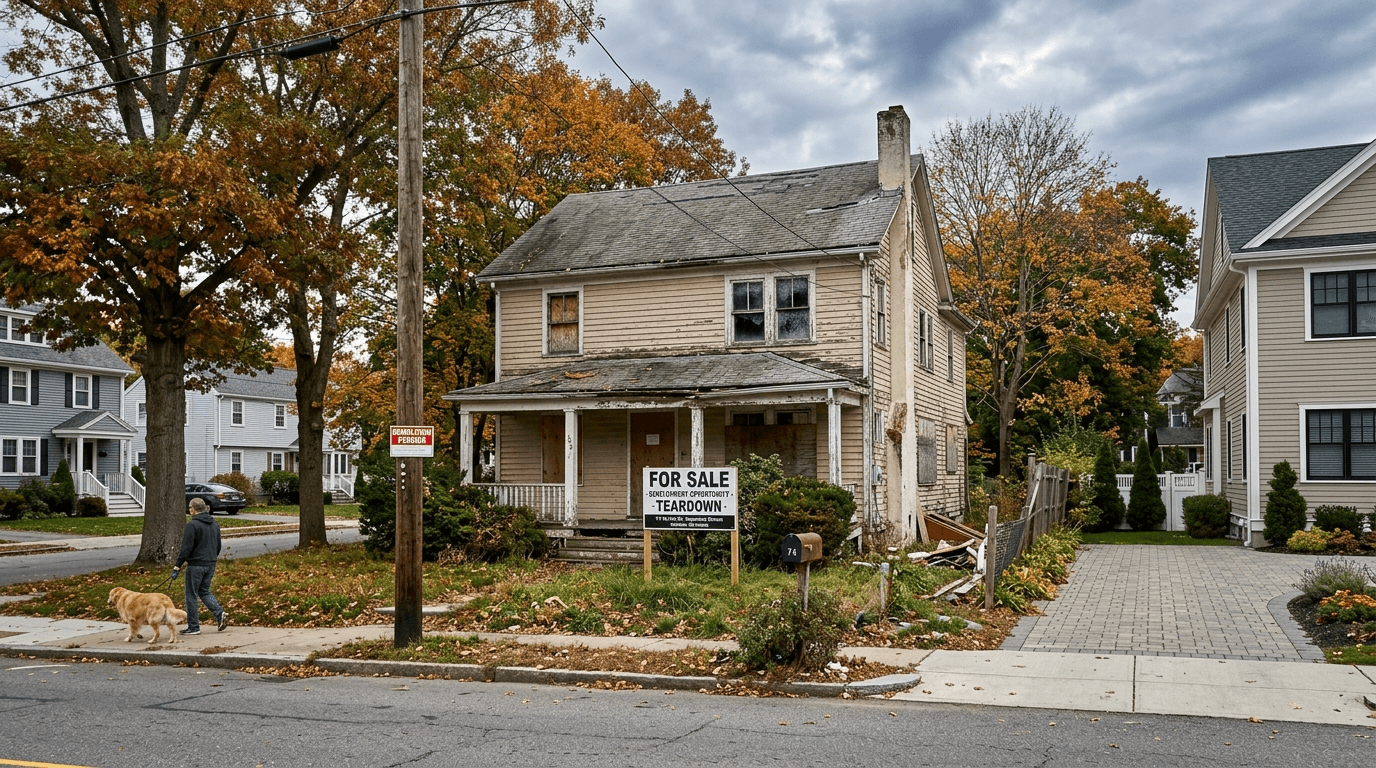
•The reality check: Teardowns haven't stopped. Per the Newton Beacon's account of the September 17 Zoning and Planning meeting, Councilor Pamela Wright reported more than 400 homes demolished.
•Your action item: Measure the frontage before you write an offer. It's a starting filter, not a verdict — corner lots, special permits, and a pending size-limit debate can all override it.
Why Does Lot Frontage Suddenly Matter More Than Your Budget?
Most move-up buyers treat a Newton teardown as a money question. Find the tired ranch. Write the check. Build the dream.
The arithmetic explains why. Single-family homes ran a median $1.55M in Q1 2026, against $735,000 for condominiums and $1.2M for multi-family properties. Single-family land is where the money is, so that's where the bulldozers go.
Median Home Prices by Property Type — Q1 2026
Median prices by property type in Newton as reported for Q1 2026.
| Series | Label | Value |
|---|---|---|
| Median price | Single-family | $1.55M |
| Median price | Condominiums | $735,000 |
| Median price | Multi-family properties | $1.2M |
Now it's also a geometry question at the curb. Per the Newton Beacon's reporting on the Residential Facade Build Out Ratio, a new house's front wall can't cover more than 60 percent of the lot's frontage. The City Council approved the rule 18–5, with one member absent, according to the Newton Beacon and The Heights.
Newton's villages are no longer one uniform teardown market.
What Do the Exemptions Actually Do to Newton's Village Map?
Per the Beacon's reporting on the ordinance:
•On a 100-foot frontage, a new front facade can still run 60 feet wide.
•On a 60-foot frontage, it drops to 36 feet — tight for a modern four-bedroom plan.
•Lots narrower than 50 feet are exempt.
•Additions under one and a half stories sit outside the rule.
•A special permit can allow more width, at the cost of time and uncertainty.
The 50-foot exemption is the key detail here. Utile Architecture and Planning, the consultant Newton hired, studied 2017–2022 sales, per the Beacon's account of the committee. Associate Loren Rapport said demolished homes "tend to be smaller… on larger lots and generally built post World War II." He also said roughly one in ten Newton home sales ends in a teardown.
So the fuel is the wide postwar lot, not the narrow village-core lot — though those sales predate the rule. Builders may now go deeper, go taller, or chase special permits, so expect side-loaded garages and more house tucked behind the front wall.
Ward 3 Councilor-at-Large Andrea Kelley pushed back, per the Beacon. The rule "doesn't consider a majority of Newton's lots," she warned — especially smaller lots and irregular corner lots. That, she said, makes the process "lengthier, more expensive, and convoluted." If she's right, the rule's reach stops at the wide lots it actually touches.
Which Newton Villages Are Rebuild Zones, and Which Are Renovation Zones?
Sort your target streets by lot width and housing stock. Typical widths vary sharply by village, so check your specific street — the groupings below are an estimate, not a survey.
Rebuild zones: frontages wide enough to absorb the 60 percent cap — Oak Hill, Chestnut Hill, Waban, and wider-lot parts of Newton Centre and West Newton Hill. Ground-up construction still works here. Assume demolition within sight of your porch.
Exempt-by-width zones: lots below the 50-foot exemption line — Nonantum, Upper Falls, and denser blocks of Newton Corner, Newtonville, and Lower Falls. The rule often passes over these lots entirely, so it won't be the deciding factor either way.
The pinch zone: lots just above the exemption line — much of Auburndale, Newton Highlands, Thompsonville, and interior-grid parts of West Newton and Newtonville. A deep renovation plus a rear addition may be the easier path here, though a special permit remains a workaround for a determined builder.
Price doesn't map onto frontage. In village listing medians — asking prices, not sales — compiled by agent Andrea Forsythe in a Newton Highlands village guide, Oak Hill tops the list at $2,949,000. It's a wide-lot rebuild zone. But Newton Upper Falls, where most lots are exempt, still lists at $1,750,000. High prices alone won't tell you whether the house next door is a teardown candidate.
Median Listing Prices Across Newton Villages
Village-level median listing prices position Newton Highlands and other villages within the broader Newton market.
| Series | Label | Value |
|---|---|---|
| Median listing price | West Newton | $1,299,000 |
| Median listing price | Newton Highlands | $1,450,000 |
| Median listing price | Newton Corner | $1,662,000 |
| Median listing price | Newton Upper Falls | $1,750,000 |
| Median listing price | Newtonville | $1,895,000 |
| Median listing price | Newton Centre | $2,395,000 |
| Median listing price | Waban | $2,650,000 |
| Median listing price | Oak Hill | $2,949,000 |
What Are the Best Arguments Against the Rule?
"A frontage cap only controls the front wall. Builders will go deeper and taller." Mostly true. The rule reshapes new homes; it doesn't cap their size. Per the Beacon's account of the committee, Wright and Councilor Sean Roche have discussed adding a size limit that tightens as lots get smaller — a floor-area-ratio cap, or how much house is allowed relative to lot size. Ward 7 Councilor Lisle Baker chairs Zoning and Planning. He said the consultant chose 60 percent to improve the built environment "without adversely affecting the property values of the properties themselves." This is a rule about shape and bulk, not a teardown ban.
"The exemptions gut the rule." Not exactly. The exemption removes many narrow village-core lots, but Utile found demolished homes cluster on larger postwar lots — precisely the lots the rule reaches.
"2026 is distorted because people rushed permits before the rule started." Fair point. Per the Beacon's account of the committee, Baker said the effective date had to give people with "reasonable expectations" time to finish what they'd started. Lot widths don't change with a permit rush, though, which is why frontage is a steadier guide this year than permit counts. The first clean read on village trends will come when the council revisits the rule — Councilor Susan Albright has asked for that review, per the Beacon's account of the September 17 meeting. That same account puts demolitions above 400; how many came after the rule took effect hasn't been broken out publicly.
Has Newton's Teardown Era Actually Ended?
No. The rule changed the design game, not the market.
Per the Newton Beacon's account of the September 17 meeting, Wright said 239 houses have been built on demolished lots. Purchase prices near $1.2 million turned into a median sale price of $3.6 million. Ward 6 Councilor-at-Large Lisa Gordon reacted bluntly:
"This is way worse than what I knew anecdotally."
Roughly tripling the money is an incentive a facade-width rule doesn't touch. Closing that gap would take a size cap plus enough special-permit friction to make demolition slower than renovation. Neither is in force yet.
Demand is the engine. As Roche put it:
"The problem we have is a problem of market demand."
The May 2026 citywide numbers show what he means. Newton's median sold price was $1,700,000 — above the $1.55M Q1 single-family figure, which covers an earlier window. Homes sold for about 98% of asking price, leaving little room to negotiate. At those prices, a tired ranch on a wide lot is still worth more to a builder than to most buyers.
Newton Housing Market Snapshot — May 2026
Citywide mixed-unit snapshot for Newton from Realtor.com covering pricing, inventory, market pace, negotiation room, and rent in May 2026.
May 2026 citywide
Median listing$1,878,000
Median sold$1,700,000
Active listings285
Median days on market24 days
Sale-to-List price ratio98%
Median rent$3,757/mo
What Should You Do Before the Council's Review?
Measure the frontage. It's a starting filter, not a verdict.
•Under 50 feet: the rule is likely less relevant next door.
•Just above 50 feet: renovation may beat demolition more often.
•Well above 50 feet: expect builders to keep looking closely.
Renovating? Additions under one and a half stories sit outside the ratio, so a rear-and-up project may be the cleaner path in pinch-zone villages. Building? Budget time as well as money — corner and irregular lots draw more design work and review.
You buy in Newton for stability, village feel, schools, and long-term value. The construction map is changing underneath that. Start with frontage, lot shape, and recent teardown activity on your block, then confirm current exemption thresholds with the Newton Planning Department before you write an offer.