Key Takeaways
•What the 'F' really means for you: Massachusetts earned a failing affordability grade because prices keep outrunning wages while inventory stays thin — and that grade has now triggered three real policy shifts, not just more stalled bills.
•The three levers already moving: ADUs (Accessory Dwelling Units) are legal by right statewide, the state is suing towns that won't rezone near transit, and a proposed transfer fee could tax high-end sellers.
•The bottom line for buyers and sellers: Where you buy, what you can build in your backyard, and what a seller nets at closing now depend on your specific town's compliance and price tier.
What does Massachusetts' "F" actually mean in 2026?
If you're trying to buy, sell, or just stay put in Massachusetts, that "F" on affordability isn't just a bad grade — it's pressure that's now forcing real policy changes.
For years, homeowners figured affordability talk meant more studies and more stalled bills gathering dust on Beacon Hill. Not anymore. On January 29, 2026, the Massachusetts Attorney General sued nine towns that had refused to allow multifamily housing near transit, according to Law360. Weeks later, on March 4, 2026, the state's highest court seemed ready to reject a town's challenge to that same law, Law360 reported.
So why the failing grade? Two simple reasons: prices keep rising faster than paychecks, and there still aren't enough homes for sale. Massachusetts prices climbed 2.22% over the past year — faster than the national pace, though slower than several neighboring New England states, per the FHFA House Price Index.
Massachusetts Home Prices Are Rising, But Not at the Top of the Pack
Selected state and national FHFA House Price Index one-year percent changes, with Massachusetts shown against nearby New England states and the U.S.
| Series | Label | Value |
|---|---|---|
| 1-year HPI change | Illinois | 7.31 |
| 1-year HPI change | Vermont | 4.95 |
| 1-year HPI change | Connecticut | 4.68 |
| 1-year HPI change | New Hampshire | 3.31 |
| 1-year HPI change | Maine | 2.43 |
| 1-year HPI change | Massachusetts | 2.22 |
| 1-year HPI change | United States | 1.65 |
| 1-year HPI change | Rhode Island | -0.69 |
When prices are already high, even a modest annual jump can push buyers out of reach. Sellers might read that as good news, but the same squeeze follows them into their next purchase.
The "F" is the backdrop for three major changes now reshaping local markets: ADUs, MBTA Communities zoning, and possible transfer fees.
Can an Accessory Dwelling Unit (ADU) — a small second home on your lot — help owners create more flexibility?
The biggest change for many homeowners is happening right in the backyard. An ADU is a small second home on the same property — an in-law apartment, a backyard cottage, a granny flat, whatever you want to call it.
Under a recent state law, part of a $5.1 billion housing bond bill signed by Gov. Healey, an ADU is now allowed by right in any single-family zone, per MassLive. The law took effect statewide on February 2, 2025.
That phrase — "by right" — matters more than it sounds. You no longer need a special permit or a drawn-out zoning fight just to ask permission. That removes one of the biggest roadblocks owners used to face. For you, an ADU can mean:
•Rental income to help cover a mortgage
•Space for an aging parent or an adult child
•More options if you want to stay in a high-cost town
This isn't just a policy idea sitting on a shelf, either. More than 1,200 ADUs were approved in the first year alone, with state construction financing expected in 2026, per the Executive Office of Housing and Livable Communities.
ADUs Are Moving From Policy Idea to Real Pipeline in Massachusetts
Early statewide snapshot of accessory dwelling unit approvals under Massachusetts’ by-right ADU standard and the planned financing timeline.
Current approvals
Approved ADUs (first year)More than 1,200
Future financing
MassHousing construction financing start year2026
A house that can support extra living space becomes more useful to your family now — and more attractive to future buyers later.
One notable exception: Boston is exempt and writing its own ADU rules, per MassLive. If you own property in Boston, hold off on designing or budgeting your project until local guidance lands.
Key takeaway: If your lot might qualify, price out an ADU now. It could double as a lifestyle fix and a long-term value boost.
How does MBTA Communities zoning affect buyers and sellers?
For decades, local zoning boards held all the cards on what could get built in each town. That control is shifting fast.
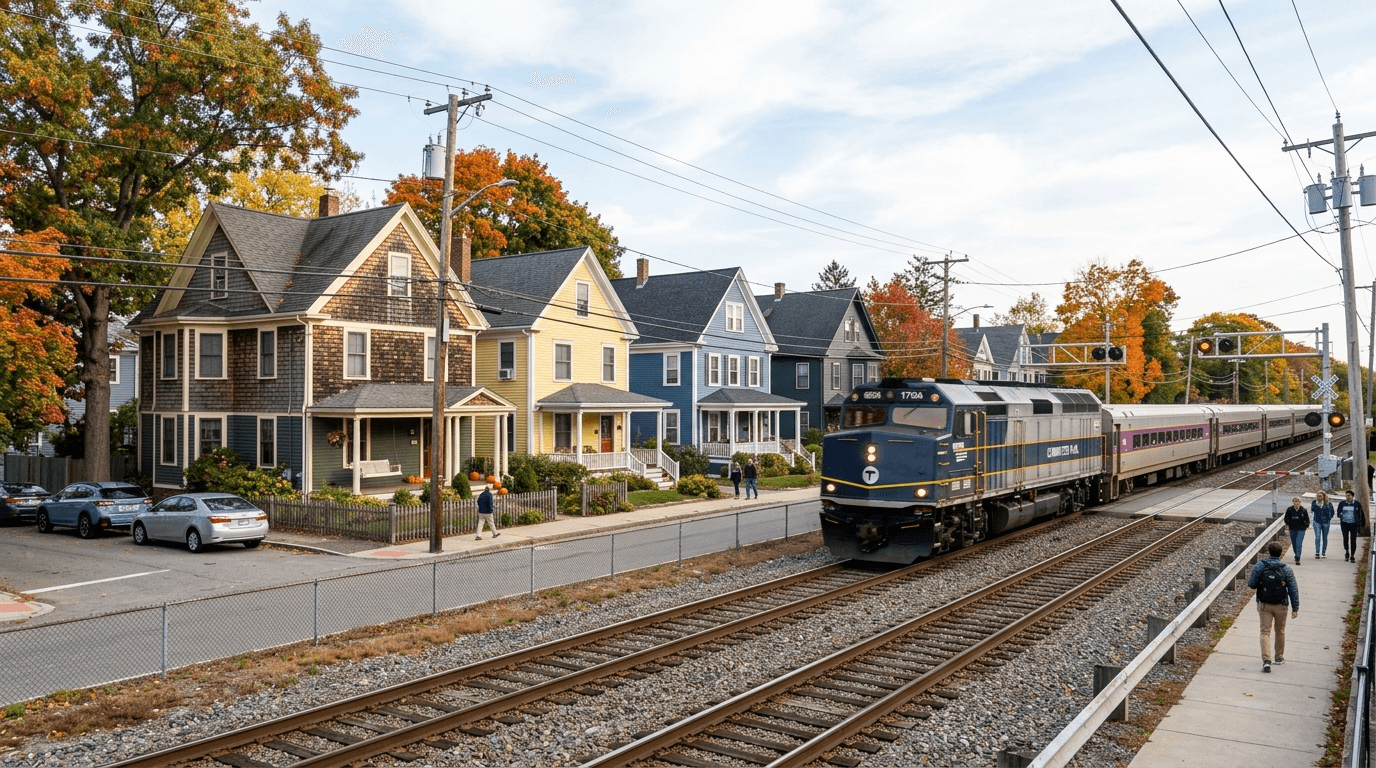
The MBTA Communities law covers 177 cities and towns across Massachusetts, per MassLive, requiring transit-connected communities to allow more housing near trains, subways, ferries, or bus routes. Commuter rail municipalities make up the largest group — 71 of them.
Most MBTA Communities Are Commuter Rail or Adjacent Communities
Counts of Massachusetts MBTA-designated municipalities by community category.
| Series | Label | Value |
|---|---|---|
| Municipality count | Rapid Transit municipalities | 12 |
| Municipality count | Commuter Rail municipalities | 71 |
| Municipality count | Adjacent municipalities | 59 |
| Municipality count | Adjacent Small Towns | 35 |
As of 2026, compliance isn't really optional anymore. Between the Attorney General's lawsuits and the court's skepticism in March, holdout towns are running out of legal cover.
For buyers, this plays out block by block. A home near a station might sit in an area where new apartments or condos suddenly become possible — more housing choices, better walkability, a different neighborhood feel that could shift resale value down the road.
Sellers feel this both ways. More units nearby could mean more competition, but transit-connected housing tends to pull strong demand from buyers chasing easier commutes. Don't judge a town by today's listings alone — look at what the zoning map now allows.
Key takeaway: Before buying or selling near a transit corridor, check whether the town is compliant, resisting, or already facing state action.
Could a transfer fee change what sellers net at closing?
The third lever is the shakiest one: a possible transfer fee.
Gov. Healey proposed letting towns charge a fee of 0.5% to 2% on high-value sales, per the Boston Herald. It would apply to sales over $1 million or the county median, with the seller footing the bill. Boston's mayor wants 2% on sales over $2 million, the Herald reported. The money adds up fast: the state estimated $392 million for every 1% levied statewide.
But it's not a clean win. A Greater Boston Real Estate Board and Tufts report warned cities could lose "nearly 60 cents for every dollar collected," and a 2019 Boston analysis found a 1% fee would shave roughly 1% off values while dragging down sales volume too.
If you're selling a higher-priced home, this fee could eat into your net proceeds — what you actually walk away with after closing costs, taxes, mortgage payoff, and fees. Your exposure hinges on the town and whatever final rules emerge. Roughly a dozen home rule petitions are pending, mostly on Cape Cod and the Islands, per CommonWealth Beacon, though the idea faces "an increasingly uphill climb" in the Legislature. Consider this a wildcard, not a done deal.
Key takeaway: If your home could sell above $1 million, ask about local transfer-fee risk before locking in your timing or price strategy.
What are the strongest arguments against these policies?
Fair question: will these changes actually move the affordability needle?
First, the scale problem. Even at more than 1,200 ADUs in year one, that's a drop in the bucket against the statewide shortage — and rezoning only changes what's allowed, not what actually gets built. Still, the mechanism matters: ADUs are now legal by right, which clears out a major permit bottleneck, and MBTA Communities enforcement has real teeth behind it.
Second, transfer fees could backfire. Critics argue extra costs discourage sales and development — the same disincentive argument used against inclusionary zoning in cities like Chicago. That risk is real, and Massachusetts' version remains unsettled; the actual impact will hinge on thresholds, exemptions, and local adoption.
Third, towns will keep resisting — and they are. Legal momentum favors state enforcement, but lawsuits and appeals can stretch compliance out for months or years. A town's zoning might not shift on the timeline the headlines suggest.
Bottom line: treat these policies as a tailwind, not a guarantee, and verify your specific town's current status before you act on any of it.
What should you do now if you are buying or selling?
That "F" on affordability isn't a static grade. It's a warning that Massachusetts housing rules are changing in real time.
If you're buying:
•Check your target town's MBTA Communities compliance status.
•Look closely at transit-adjacent areas where future supply may shift.
•Consider whether an ADU-ready property buys you more long-term flexibility.
If you're selling:
•Ask whether a transfer fee could hit your town or price tier.
•Understand whether nearby zoning changes could shift buyer demand.
•If your lot could support an ADU, make sure that value gets highlighted.
The strongest long-term position is simple: an ADU-ready property in a compliant, transit-connected town gives you more options — and that matters in a state where options keep getting pricier. Want to know how these policies play out for your specific town, neighborhood, or property? Ask for a local zoning-and-market review before your next move.