I'm Andrea Forsythe, a Newton, MA real estate agent specializing in new construction. With 13+ years developing homes, I guide buyers and sellers from search to keys. Serving Newton, Brookline, Watertown, Belmont, Waltham, Wellesley, Wayland, Arlington, Natick, Needham, Stoneham, Wakefield and Lexington, MA.
# Is Staging Worth It in Brookline?
Key Takeaways
•Staging helps you compete: In a 2025 national home-staging study of 15 major metros, staged homes sold in 23 days versus 47 days for unstaged ones. And in one home I personally listed in Brookline, staging was one factor in a stronger final result — more on that story below.
•The reality: In a fast Brookline market, buyers aren't just comparing square footage. They're deciding which home feels easiest to picture living in.
•The bottom line: Get the light, wellness cues, and room definitions right, and you help your home present well from the first online photo.
Let's be honest about what staging actually is.
It's easy to assume it means fluffing pillows, clearing counters, and making a home look "nice." In Brookline, though, it's a much bigger deal than that.
Buyers aren't shopping for a floor plan. They're shopping for a feeling — that immediate, gut-level sense of I can live here. And right now, with Brookline homes moving in just 17 days on market, you don't get much time to make that impression.
Brookline’s Current Market Pulse
A quick mixed-unit snapshot of Brookline’s current market speed, supply, pricing power, and mortgage-rate backdrop.
Current Market Indicators
Days on Market17 days
Months of Supply3.1 months
Sale-to-List Ratio97.68%
Mortgage RatesCurrently- 6.23% projected to hover between 6.0% and 6.8%
Two terms worth knowing here: sale-to-list ratio tells you how close the final sale price lands to the asking price, while months of supply tells you how long it would take to sell every active listing at today's pace. Together, they reveal who holds the upper hand — buyer or seller.
"Well-presented" is the operative phrase. When buyers can't immediately understand a space, they hesitate. And hesitation costs you time, leverage, and money.
Is Staging Really Worth It in Brookline?
Yes — when it's done with a clear plan.
Brookline home prices are forecast to rise 2–4% in 2026, which means sellers should plan for modest, steady growth rather than banking on a sudden market surge.
Brookline 2026 Price Outlook
A simple forecast card showing the expected direction of Brookline home prices in 2026.
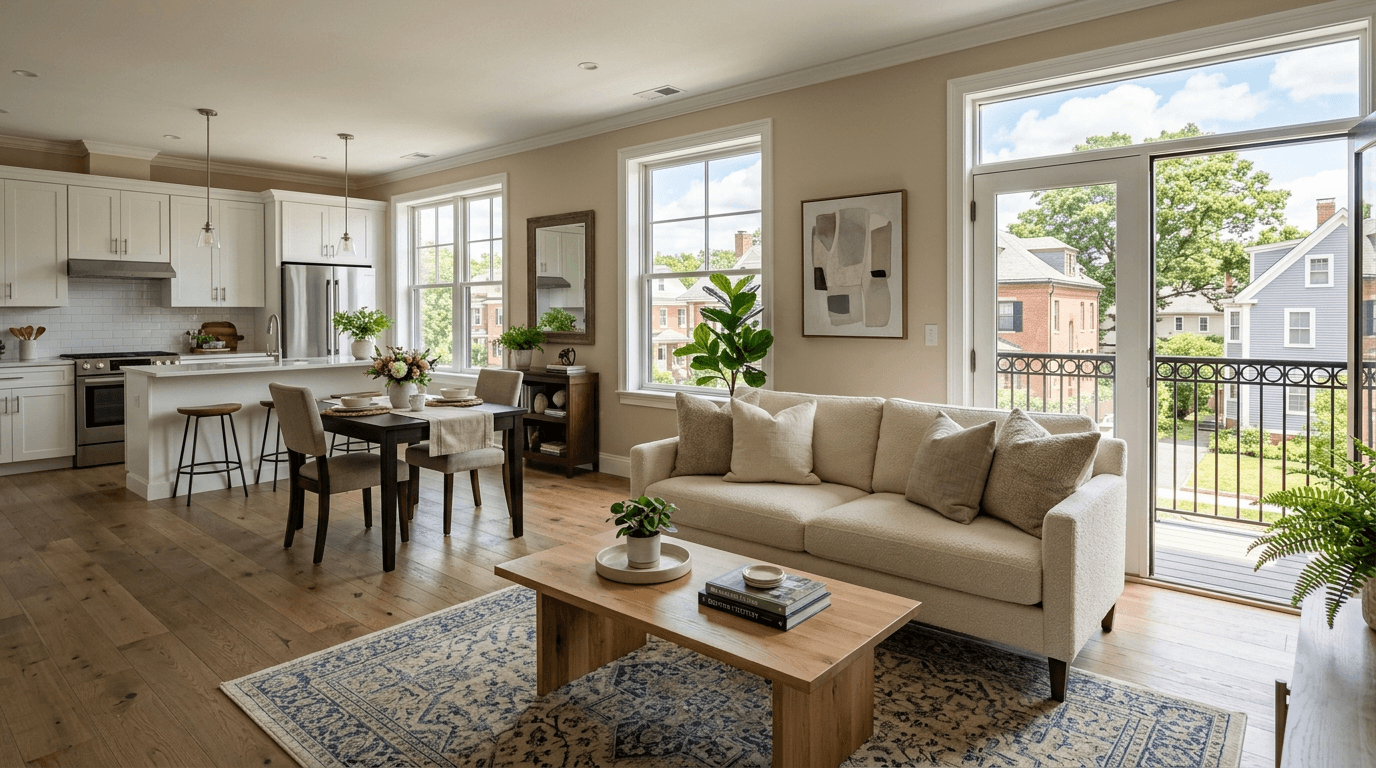
Staging isn't decorating for decoration's sake. It's about helping buyers see the best version of the home — and that shows up in very practical ways:
•Better photos online
•Clearer room purpose
•Stronger first impressions
•Less buyer doubt
•More emotional connection
That emotional connection matters, though it plays out differently depending on the price point. At entry and mid-range levels, buyers often lean hardest on how a home feels because they're stretching to picture their daily life there. At the top of the market, buyers scrutinize real amenities more closely, so staging works best when it spotlights genuine features rather than masking their absence. Either way, staging shapes the first impression — it just can't rewrite the facts of the house.
What Happened With One Brookline Home I Listed?
This is one home, one story I lived through — not a study result.
We listed a property in the fall for $2,000,000, unstaged. A few offers came in. None of them appealed to the seller.
So we made a call.
We staged the home and relaunched in the winter — this time at $200K more.
It sold within the first few weeks for $2,150,000.
I want to be straight about what this story can and can't prove. The sale came in $50K below the relisted ask, and the winter relaunch plus the repricing decision were both moving parts. Staging wasn't the only factor — seasonal timing mattered too. What I can say with confidence is that staging changed how buyers experienced the rooms.
Unstaged, buyers saw someone else's house. Staged, they saw their future.
That's the difference you're trying to create — as one meaningful factor among several, not a guaranteed formula.
What Should You Do First Before Staging?
Start with a deep clean and a serious declutter.
This is the lowest-cost, highest-return step in the entire process. Before furniture, art, or any styling decisions, the home needs to feel fresh, open, and easy to trust. Clean spaces photograph better and signal to buyers that the home has been genuinely cared for.
Do this first:
•Empty the counters
•Clear the closets
•Remove extra furniture
•Pack away personal items
•Clean windows, floors, trim, and fixtures
Buyers mentally move in when your things aren't in the way. A spotless, decluttered home gives them fewer reasons to hesitate — or negotiate down. That's where staging earns its keep, even before a single piece of furniture gets moved.
How Much Does Light Matter to Brookline Buyers?
A lot. More than most sellers expect.
A bright room feels bigger, cleaner, and healthier — and that's especially important in older Brookline homes and condos, where windows or layouts can feel more traditional. The good news is you don't need a renovation to fix it.
Focus on these simple upgrades:
•Remove heavy drapes
•Swap in light sheers
•Trim bushes blocking windows
•Add warm daylight bulbs
•Place mirrors where they'll bounce light around the room
Better light can make a room feel more livable in seconds. It helps buyers feel calm rather than cramped — and that feeling sticks.
Should You Stage Around Wellness?
Yes, but keep it subtle.
Wellness staging doesn't mean turning the home into a spa showroom. It means showing buyers where daily life can feel genuinely good.
Think along these lines:
•A quiet reading corner
•A small yoga or stretching space
•Healthy plants
•A calm, uncluttered bedroom setup
•A clean, bright bathroom
Beyond the styling, make your home's real features easy to notice. If you have updated windows, heating, cooling, filtration, or bathroom improvements, the way you style and describe the home should draw attention to them.
Here's the honest catch: you can't stage in heated floors or a spa shower. But many buyers walk right past valuable features unless they're clearly highlighted. Staging helps draw the eye to what's already there. And when those premium features aren't present, staging still moves the needle on the things buyers feel immediately — light, flow, and room purpose.
Why Should Every Room Have a Clear Purpose?
Because undefined rooms make buyers work. And when buyers have to work, they hesitate.
A spare room that feels like a storage zone, a wide hallway that feels like wasted space, a corner that feels forgotten — these are all missed opportunities. Use rugs, furniture, lighting, and scale to create clear zones:
•Breakfast spot
•Home office
•Reading nook
•Guest room
•Primary-bedroom retreat
•Play area
•Workout corner
This matters especially for Brookline condos, which drove the bulk of sales last quarter.
Brookline Q2 2026: Single-Family vs. Condo Sales Volume
A comparison of Q2 2026 closed sales counts by property type in Brookline.
A comparison of Q2 2026 closed sales counts by property type in Brookline.
With 101 condo sales versus 33 single-family sales in Q2 2026, condos accounted for the majority of market activity. Defined zones show buyers exactly how the home lives — and that can help justify the price because no one is left guessing what to do with a room.
Should Your Listing Lead With Lifestyle Instead of Square Footage?
Yes, every time.
Almost every buyer sees your home online before they ever set foot inside. Your photos are the first showing. So the listing needs to tell the right story immediately — lead with the rooms and moments that make the home feel easy to love:
•Sunlit living space
•Calm primary bedroom
•Defined home office
•Wellness nook
•Outdoor space, if you have it
•Clean kitchen and bath areas
Short captions can help buyers picture the space. Simple labels work well — something like "sunlit morning yoga nook" or "quiet work-from-home space."
One rule: stage before photography.
In a 2025 home-staging study of 15 major metros, homes staged before photography sold in 19 days on average.
Staging Timing and Average Days on Market
A time-sequenced view of how later staging timing corresponds with longer average days on market.
A time-sequenced view of how later staging timing corresponds with longer average days on market.
Wait until the listing has been sitting for 30+ days and that average climbs to 45 days, according to the same study.
First impressions compound. Once a listing starts to feel stale, buyers begin wondering what's wrong — and that doubt tends to show up as lower offers or pressure for a price cut.
What Are the Strongest Arguments Against Staging?
Fair question. Here are the real objections, addressed directly.
Is the Wellness and Light Data Specific to Brookline?
Not all of it. Design signals like wellness, natural light, and open layouts come from national and design-industry sources, not Brookline-only data. Treat those recommendations as national benchmarks that should guide your choices — not as local proof.
What is local is the Brookline pricing picture: single-family homes carried a median price of $2,700,000 over the last 12 months, versus $1,035,000 for condos.
Interestingly, condos — the smaller, more affordable segment — often command a higher price per square foot than large single-family homes. That's not a knock on staging. It reflects how buyers value compact, walkable, well-used space in denser neighborhoods, while single-family buyers are paying for total size, land, and privacy. The two segments run on different pricing logic. Staging can't erase that gap, but it can help either type of home show its space to best advantage.
Can Staging Replace Major Features Like Heated Floors or a Luxury Shower?
No — and it was never meant to.
Staging can't create features your home doesn't have. What it can do is help buyers notice the strengths that are already there. If your bathroom is updated, staging makes it feel cleaner and more spa-like. If your bedroom gets great morning light, staging makes that obvious. If you have a flexible room, staging gives it a purpose.
This is also where the "buyers buy a feeling" idea meets its limit. Feeling drives the first impression and gets a home onto the shortlist — especially for entry and mid-market buyers. But sophisticated, higher-end buyers still verify the real amenities before they pay a premium. Staging is the lens that helps buyers see the house clearly, not a substitute for the house itself.
So, Is Staging Worth It?
Yes — as one meaningful lever among several.
The national picture points the same direction: in that 2025 study of 15 major metros, staged homes sold in 23 days versus 47 days for unstaged ones.
Staged vs. Non-Staged Homes: Performance Metrics
A multi-metric comparison of staged and non-staged properties across market speed, pricing, showings, and offer activity.
Average Days on Market
Sale Price vs. List Price
Properties Selling Above List
Buyer Showing Requests
Offer Rate Within 30 Days
A multi-metric comparison of staged and non-staged properties across market speed, pricing, showings, and offer activity.
A quick note on the different "days on market" figures you've seen throughout this article, since they come from different places. The 17-day figure is the recent Brookline market average across all homes. The 23-day and 19-day figures are national study averages across 15 major metros, comparing staged homes to unstaged ones (47 days) — not Brookline-specific results. So staging's value in the study isn't about beating the local average; it's the large gap between staged and unstaged homes within the same national dataset. In a market as fast as Brookline's, staging is less about avoiding a stale listing and more about protecting your price and negotiating position when buyers are already moving quickly.
Not every home needs the same staging plan. Some need full staging. Some need partial staging. Some just need cleaning, editing, better lighting, and clearer room definition. But the goal is always the same:
Help buyers picture the life they want — inside your home.
If you're thinking about selling in Brookline, don't guess. Let's look at your home, your price point, and your likely buyer together. Want to know whether staging would pay off for your specific property? Send me your address. I'll tell you exactly where staging is worth spending — and where it isn't.
Common Questions
Is staging worth it when selling a home in Brookline?
Staging is worth it when you want to sell a home in Brookline faster and with a stronger first impression. The article shows staged homes sold in 23 days versus 47 days unstaged, and one Brookline listing sold for $150,000 more after staging and relaunching.
How does Brookline home staging help buyers picture themselves living there?
Brookline home staging helps buyers see the home as their future, not someone else’s space. Clean rooms, better light, defined zones, and lifestyle cues make each room easier to understand, so buyers can imagine daily life instead of trying to mentally redesign the home.
What should sellers do before paying for full staging?
Sellers should start with a deep clean and decluttering before bringing in furniture or decor. The article calls this the lowest-cost, highest-return step because clean counters, clear closets, and spotless rooms photograph better and make the home feel move-in ready to Brookline buyers.
How does wellness home staging work in Brookline?
Wellness home staging works by using simple, subtle cues that make a home feel bright, calm, and healthy. The article suggests plants, a reading corner, a meditation spot, a yoga space, and highlighting real upgrades like newer windows, heating improvements, or clean filtration paperwork.
Does staging before photography matter for Brookline listings?
Staging before photography matters because most buyers see the listing online first. In the article’s data, homes staged before photos sold in 19 days on average, while homes staged after 30-plus days averaged 45 days. Strong first photos help keep a listing from feeling stale.
Can staging make a Brookline condo feel larger or more useful?
Staging can make a Brookline condo feel more useful by giving every area a clear job. Rugs, furniture, and lighting can create a breakfast spot, home office, or bedroom retreat. This matters because Brookline condo buyers are often paying for walkable, well-used space.